Who Are You When the Thing That Defined You Disappears?
I've noticed that the hardest funks to climb out of aren't the ones where something goes wrong. They're the ones where something ends.
The part where you've spent years, decades, building an identity around something — a career, a role, a version of yourself — and then one day that thing is gone and you're standing there going, okay, so who am I now?
That question is brutal. And the tricky part is it doesn't announce itself dramatically. It sneaks up on you in weird moments. You introduce yourself at a party and hesitate. Someone asks what you do and you give an answer that doesn't quite fit anymore. You feel vaguely fraudulent in your own life. I have been there. Most of us have, if we're honest — whether it's leaving a career, ending a relationship, becoming a parent, or watching a chapter close that we thought would last forever.
When we lose something that was central to who we are, not just what we do, it's genuinely destabilizing. Psychologists call it an identity crisis, which sounds dramatic but is really just a fancy way of saying: I don't know how to answer the question "who am I" right now, and that's terrifying. The research is pretty clear that the stronger the tie between our sense of self and a specific role — soldier, CEO, caregiver, athlete — the harder the landing when that role disappears.
And here's where it gets interesting. Because sometimes, just when you're starting to rebuild, life adds more to the pile.
I think that's the part we really don't talk about enough. We love a comeback story, but we usually skip the part where the hits keep coming mid-comeback. Where you're already down, already figuring it out, already white-knuckling your way toward something new — and then you get a diagnosis. Or a loss. Or a storm (sometimes literally). And you have to decide: do I stop here, or do I find a reason to keep going?
What I've learned — and what the research backs up — is that the people who keep going aren't the ones who feel more certain. They're the ones who set a goal big enough to justify the discomfort. Not a reasonable, sensible, "let's be realistic" goal. A goal that matches the scale of what they're up against. Because if the goal is small, the pain wins. If the goal is bigger than the pain? You've got something to move toward.
And then — this is the part I keep coming back to — it's not about grand gestures. It's about the smallest next thing. Make a cup of coffee. Ask yourself what's next. Do that one thing. Ask again. That's it. That's the whole move. Over and over until you look up and you're somewhere different than where you started.
The perception piece matters too. Same situation, two ways to see it: everything that's going wrong or everything I'm learning. One of those keeps you stuck. The other compounds.
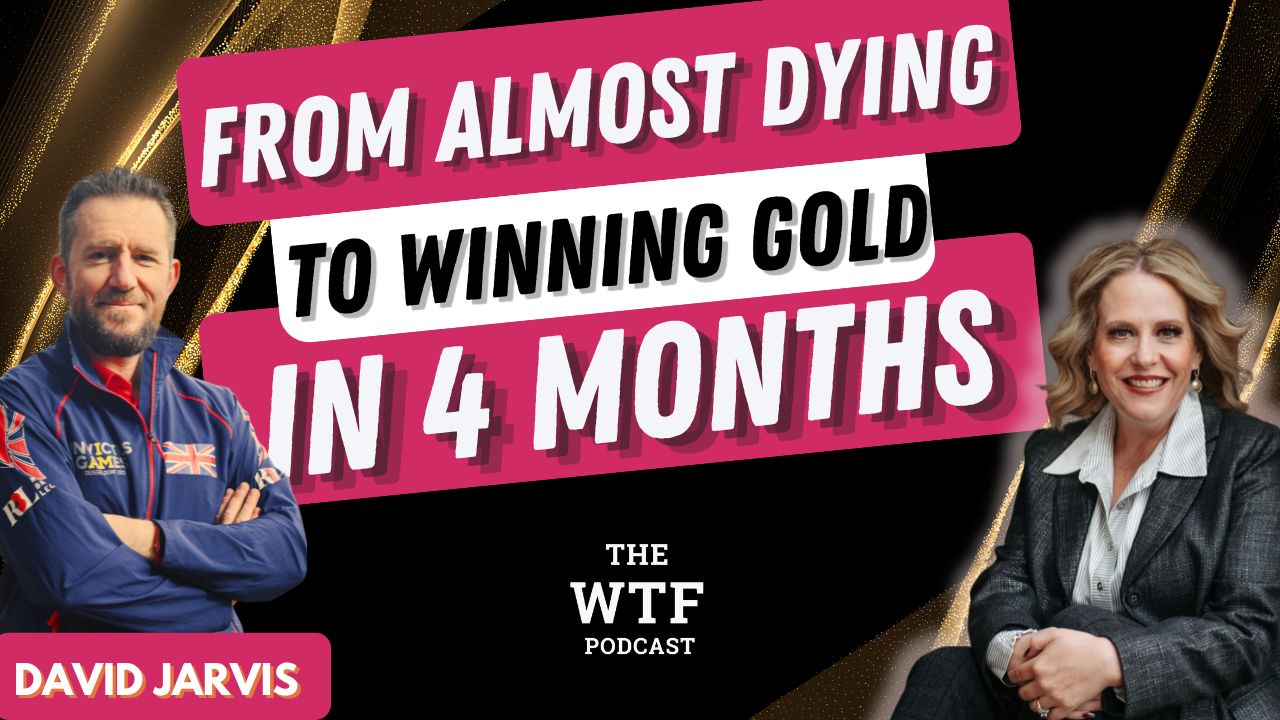
I got to sit down with someone recently who lived every single one of these concepts — not as theory, but in the most extreme, high-stakes version of real life I've ever heard. David Jarvis spent over 20 years in the British Army before being medically discharged. And just when he was starting to find his footing in a whole new identity, a new career, a new version of himself — he was diagnosed with Type 1 diabetes four months before competing in the Invictus Games. His doctor told him he might not have survived the weekend. And then told him to quit.
He didn't. And the way he navigated what came next — the identity loss, the diagnosis, the decision to set a goal big enough to carry him through all of it — is the clearest real-world example of everything I just talked about that I have ever come across.
Before you hit play, sit with these for a second:
What role or identity have you been quietly grieving — and how much of your "stuck" feeling is actually an unanswered who am I now?
If your goal right now had to be big enough to match the hardest thing you're facing, what would it actually be?
Then go listen to David's episode of the WTF Podcast. I promise it'll hit differently once you've asked yourself those questions first.


